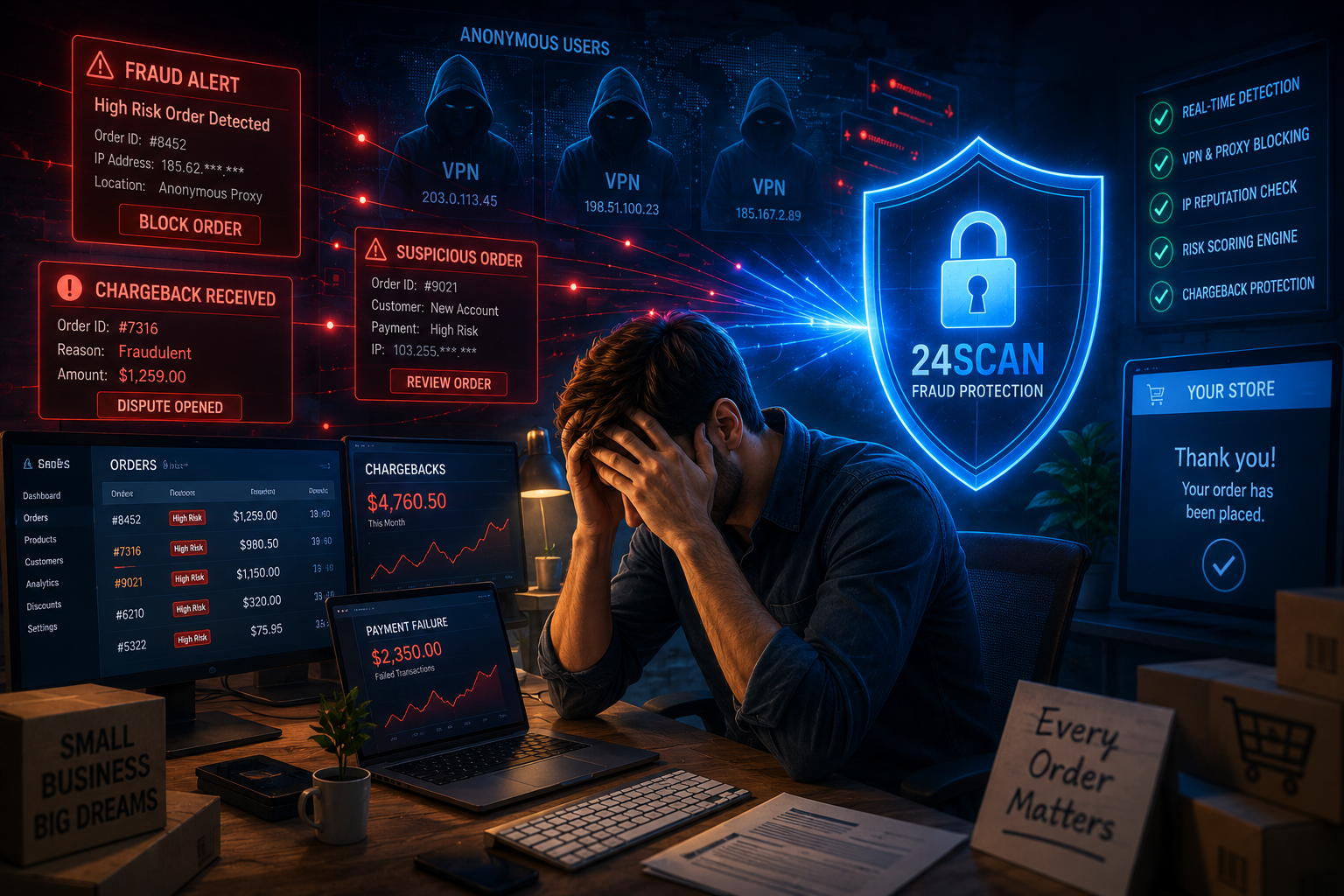
Most small business owners don’t think about fraud until it happens to them.
At first, everything looks normal.
New orders start coming in. Sales notifications feel exciting. Revenue numbers go up.
Then suddenly, a payment gets reversed.
A customer claims they never made the purchase. A shipping address looks suspicious. Or worse — multiple fake orders appear overnight from different accounts.
By the time the business owner realizes what’s happening, money has already been lost.
This is becoming a serious problem for small online stores, especially businesses selling through:
Shopify stores
WooCommerce websites
Facebook and Instagram ads
TikTok shops
digital product platforms
The difficult part is that modern fraud doesn’t always look obvious anymore.
Fraudsters now use:
VPN services
residential proxies
stolen payment methods
fake customer identities
automated order bots
To a small business owner, the order often appears completely legitimate.
The billing information matches. The customer email looks real. The IP address may even appear local.
But behind the scenes, the traffic is being hidden through anonymous networks designed to avoid detection.
And small businesses are the easiest targets because many don’t have advanced fraud protection systems in place.
Large companies usually have dedicated security teams, risk analysis tools, and payment monitoring systems.
Smaller businesses often rely only on payment processor filters, which usually catch fraud too late.
That creates expensive problems:
chargebacks
lost inventory
wasted shipping costs
payment disputes
damaged merchant reputation
For some small stores, just a few large fraudulent orders can seriously hurt monthly profits.
And the bigger problem is that fraud tends to scale quickly once attackers find a vulnerable store.
One successful fake transaction often turns into many more.
That’s why proactive fraud prevention matters now more than ever.
At 24Scan, we focus on helping businesses identify suspicious users before fraudulent orders are completed.
Instead of waiting for chargebacks, modern fraud systems analyze traffic behavior in real time:
VPN usage
proxy detection
IP reputation
risk scoring
suspicious browsing behavior
This allows businesses to stop high-risk users before payments are processed.
And for small business owners, that protection can make a massive difference.
Because unlike large corporations, small businesses usually can’t absorb constant fraud losses without feeling the impact directly.
Every fake order costs real money, real time, and real stress.
The good news is that fraud prevention technology is becoming more accessible, even for smaller online stores.
And businesses that start protecting their traffic early usually avoid much bigger problems later.
Because in modern eCommerce, protecting revenue is just as important as generating it.